 On May 16th I had the chance of a lifetime to take a historical tour of the famous asylum, Willard State Hospital in Ovid, New York. By the time I passed through the gates of Willard at ten in the morning, a couple thousand people passed through the gates for the tour. This event was held as a fundraiser for the daycare center located on the premises. The childcare center operates out of the old nursing school building.
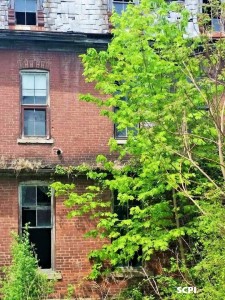
As you walk through the grounds and some of the buildings at Willard you can feel the energy of the past. A sense of desperation, darkness, loneliness and sadness. This energy appeared to be high through some of the buildings, morgue and ravine where some jumped to their death. There are several buildings on the grounds that are left to rot away. Our tour guide informed us that is cheaper to just let the abandoned buildings decay and fall in rather than demolish them. This is quite sad because so many people spent their lives working, residing and dying there. Roughly 54, 000 people came through the doors of Willard and some never left. Some for short periods of time and others spent their remaining human lives there until death and maybe even beyond
 Willard State Hospital or known as Willard Asylum for the Chronic Insane is located in the Finger Lakes region of Central New York. In 1877 it was one of the largest asylums in the country. It sat on 475 acres. It was built on the eastern widest point of Seneca Lake. This lake is one of the largest and deepest of all the finger lakes. It is named after the Iroquois nation, the Senecas. In the late 1700’s the Sullivan Expedition wiped out most of the Seneca villages along the eastern side of the lake. Nearly fifty villages of the Senecas were wiped up. The Iroquois were forced to give up their land to veterans who fight in the Revolutionary War. In 1790’s towns were established along the Seneca Lake. Willard was constructed on the lines of two towns Ovid and Romulus NY.
The concept of Willard came about because of the deplorable conditions found among the poor and chronically insane people residing in poorhouses, almshouses, asylums and institutions found throughout [New York State] NYS. Miss Dorothea Lynn Dix from Massachusetts was a reformer for the mentally ill and insane. She first brought attention to the wretched conditions found in these facilities. Most of these people residing in these places were chained to the floor or walls, filthy, no beds lived in tiny cells, some were locked in crates and had no clothing or limited clothing. They were mistreated especially the women and children who were often raped or sexually abused by other residents or employees.
 Dorothea made several pleas to the NYS legislature to improve these conditions but they were often ignored. It wasn’t until after the Civil War that NYS started to notice these living conditions. On April 30th, 1864 New York State appointed Dr. Slyvester Willard to investigate the living conditions of the poor and insane living at the NYS county poorhouses, almshouses, institutions and asylums.
The investigation found that out of 55 counties in NYS there were 1,355 reported cases of neglect, suffering or abuse occurring among the chronically insane residing in those places. The research for this article couldn’t find how many cases went unreported. A bill was then introduced into the NYS Legislative to correct these poor living conditions. It was referred to as the “Willard Bill”.
 This law allowed for the construction and design of a State Asylum for the Chronic Insane and Poor. The goal was to improve the quality of life and living conditions of the insane. This place was to be named after Dr. Willard. It was known as The Willard Asylum for the Chronic Insane. NYS wanted the facility to be centrally located, easily accessible by boat/train and in a rural area away from the mass populations. The perfect location was in Ovid. NYS had a $40,000 lien on property that the New York State of Agriculture College (what is known as Cornell University now) owned. Patients or residents could be easily transported via steamboat on Seneca Lake.
The property was already a working farm and had several buildings already erected on the grounds. The college was looking to move to Ithaca anyways. They were suffering financially because of the Civil War.
Construction and modification of existing buildings on the property began in the summer, July 1866. By the autumn of 1869 Willard was completed and the first patients arrived on October 13th, 1869. Mary Rote was the first patient and female to be received at Willard Asylum. She came from a New York almshouse in Columbia County. She was severely deformed. She lived at this facility for about ten years in horrific conditions. She was chained to the floor by her leg, had no bed and wore no clothes. She came by steamboat to Willard. Three other patients arrive the same day as Mary did. There were all male and came from various poorhouses in the surrounding areas. They came in chains and like Mary by steamboat. One came in what looked like a chicken crate. His legs were so badly deformed he was unable to walk.
 By the first year of being in operation Willard had roughly 125 males and 450 females residing there. Willard was a self- contained community and working farm. It was believed that it was therapeutic for the residents to work. Anyone who could work was expected and encouraged to do so. If you couldn’t work or had violent tendencies you were tucked away in some ward that was cold in the winter, dark and filthy. Willard provided for their basic needs but it was just custodial care. However most were treated better at Willard than the poorhouses and almshouses.
Willard housed many people from the unwanted, disabled, retardation, depressed, misdiagnosed, poor and displaced. According to a couple historians I interviewed on the tour at Willard, immigrants were often placed at Willard because of their language barriers. They were often considered to be unemployable or unskilled. My research indicates that the Irish were placed at Willard the most of all immigrants to New York State. When the Irish arrived in America they had limited resources in this country. There was a lot discrimination against the Irish as well. Most of them settle in slum areas of NYC and other NY cities. Some of them could only find jobs in domestic fields or working on the Erie Canal. Back at this time a wealthy person could declare their domestic help as mentally ill if they didn’t want them around anymore. Most of the domestic help in these wealthier homes were Irish women.
 The ratio of women residing at Willard was a lot higher than men. Women had less rights back during this time. A vicious husband could declare a wife mentally incompetent if he wanted to get rid of her with no questions asked. Some women ended up at Willard because they ended up being poor after their husbands’ deaths. A lot of men died from diseases, casualties of war and farming accidents. Women had no rights and limited resources around this time.
Sadly Mary Rote passed away after living at the asylum for eight years from tuberculosis. At the time of her death in 1877 Willard had 1,550 residents/patients. They came from all over the state and spent their remaining years there. They lived, worked and died there. Most were buried in unmarked graves on the property.
In 1890 NYS changed the classification of Willard from an asylum for the chronic insane to a state hospital. It now was known as Willard State Psychiatric Hospital. A different classification meant that they could start receiving short term patients. At the same time Willard built a railroad station or drop off in Ovid and it was connected to several railroad lines. This meant the potential for more patients to come to Willard and the accessibility was easier to other distant communities in NYS. It was also easier to transport goods and services to and from the working farm there.
As the population grew and changed at Willard so did some of the physical structures on the grounds. More buildings were erected and added throughout the years. Willard was changing as the century was approaching.
After World War II changes were happening in the mental health system. Anti-psychotropic drugs were becoming more available and the use of electroshock therapy was being used more. In the 1960’s the Mental Retardation Facilities and Community Mental Health Act came into being. It provided federal funding that allowed people to have more accessibility to mental health treatment and services. It provided funding for community mental health centers, inpatient and outpatient services, emergency treatments, hospitalization, consultations, education, research and preventative services. The goal was to decrease institutionalization of the mentally ill and insane by half within the next twenty years. This act impacted the care and needs of the residents at Willard. More were being discharged and several just came in for sub-acute care. Willard’s population started decreasing and the long term residents were becoming elderly. At one point Willard was turning into a nursing home. Eventually Willard closed down in 1995. It was in operation for more than 146 years.
Currently only a few acres remain. NYS Department of Correction owns it. There is a drug treatment facility on the grounds and the daycare center. There is also a correction facility adjunct to the grounds that the asylum is on. Willard is off limits to the public and the paranormal community at this time.
Willard has multitude of reports of paranormal activity occurring on the grounds. The correction officers working at the prison reports seeing lights going on and off in some of the abandoned decaying buildings. Shadow figures are seen from the windows of some of the buildings. Some former employees feel like they are being watched. Unfortunately paranormal investigators will never the full extent of the activity there because the NYS DOC won’t allow any investigations on the property. It is a shame because so many people have lived and died there. The cemetery where most of the residents at Willard are buried has 5,770 unmarked grave sites.
What is the future of Willard? Will the buildings just deteriorate so much they start falling down and history will be lost? So many people worked and lived their whole lives there. Many locals knew at least someone that resided or worked as an employee there. Willard has ties to the surrounding communities. Unfortunately this place will just be a memory for many and gone too soon. Some of the buildings are already beyond repair.
References for this article
The Lives They Left Behind: Suitcases From A State Hospital Attic by Darby Penney and Peter Stastny 2008
History of Willard Asylum For The Insane and The Willard State Hospital by Robert E. Doran M.D. 1978